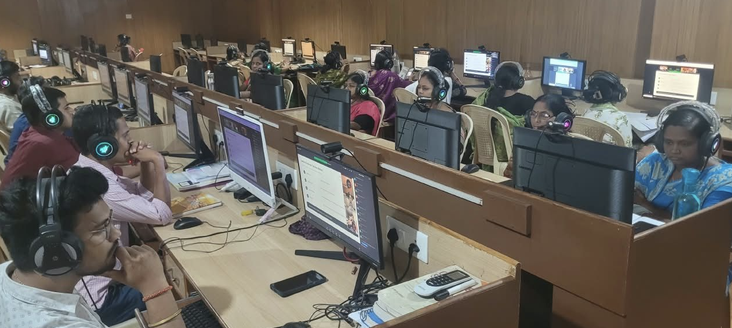
AI Training classroom in Odisha, India
When we first asked the teachers at Hariharananda Balashram how confident they felt using AI, most chose the lowest score on almost every question. Several told us they were afraid of it.
Nine weeks later, a Science teacher wrote: "Before, I was afraid. Now I confidently use it."
Between August and October 2026, The AI Access Project ran a six-session AI literacy program for 26 teachers at Hariharananda Balashram (HB), C2C's partner school in Odisha, India. HB is an English-medium CBSE school for children from tribal and rural communities, and the program continues C2C's focus on AI literacy, following our 2025 AI Literacy Workshops and the AI certification that our tutors completed over the summer.
Why Teachers Need AI Training
In a 2025 survey of more than 5,000 teachers across India by the Centre for Teacher Accreditation (CENTA), over 70% said they already use AI in their teaching. Yet only 57% correctly answered a basic question about how AI works, even though most rated their own AI expertise highly.
UNESCO's AI competency framework for teachers says that AI should complement teachers, not replace them, and teachers need the skills to use it responsibly. Without that guidance, students will learn AI on their own anyway, with no one to show them when it's appropriate and what its downsides are.
Before the program, we surveyed the teachers at HB:
Most teachers rated themselves 1 out of 5 on nearly every AI skill
Most said the school had no AI tools of its own
Most believed AI detectors are "extremely reliable," when in fact these tools often miss AI-written text and wrongly flag honest students
The teachers told us they wanted AI to save time and make lessons more engaging, but they worried that students might copy answers, stop thinking for themselves, or misuse AI in other ways.
Importance for Students
HB works with underprivileged children from rural and tribal areas of Odisha. They teach both girls and boys and every student benefits when their teachers understand AI. For the girls C2C supports, it matters even more.
In India, boys are 1.5 times as likely as girls to own a mobile phone and 1.8 times as likely to own a smartphone, according to UNFPA India. For many girls, a teacher may be the main person who can show them how to use AI, and how to use it well.
A teacher who understands AI can turn one lesson into easier and harder versions for a mixed-ability class of 40 or more, so no student is left behind or held back. At the start of the program, the school's biggest concerns were cyberbullying, inappropriate content, and exam papers leaking through AI. Teachers who understand the tools can set clear rules and respond when something goes wrong. As AI use becomes part of further study and work, students who learn how to use it appropriately will be better prepared for their future.
What the Training Looked Like
The program ran as live sessions on Zoom built around the teachers' own classroom work. Each session ended with a hands-on activity in which teachers used AI on a task from their own teaching.
Teachers learned:
What AI is, and why it can sound confident and still be wrong
How to write clear prompts and improve a weak answer with a follow-up
How to build a full lesson kit in one sitting: lesson plan, worksheet, easier and harder versions, and a marking rubric
How to check AI for errors and bias, protect student privacy, and keep exam papers out of AI tools
How to guide students: handling cyberbullying and plagiarism, setting classroom rules, and introducing AI step by step
How to use Google's Gemini tools, with a practice exam for the free Gemini Certified Educator certificate
Teachers saw results from the very first session. One task that would have taken most of them close to an hour by hand took about 20 minutes with AI. By the third session, teachers were building full lesson kits in one sitting.
Measurable Impact
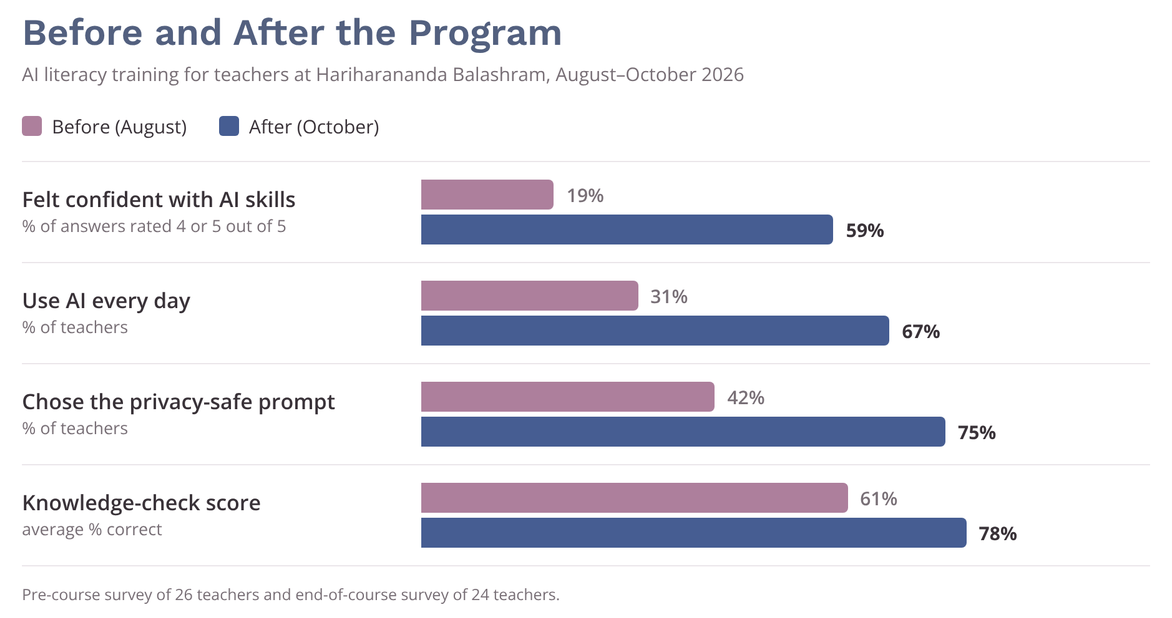
Teachers completed the same survey before the first session and after the last. Confidence nearly doubled, daily AI use doubled, and every teacher made teaching materials with AI.
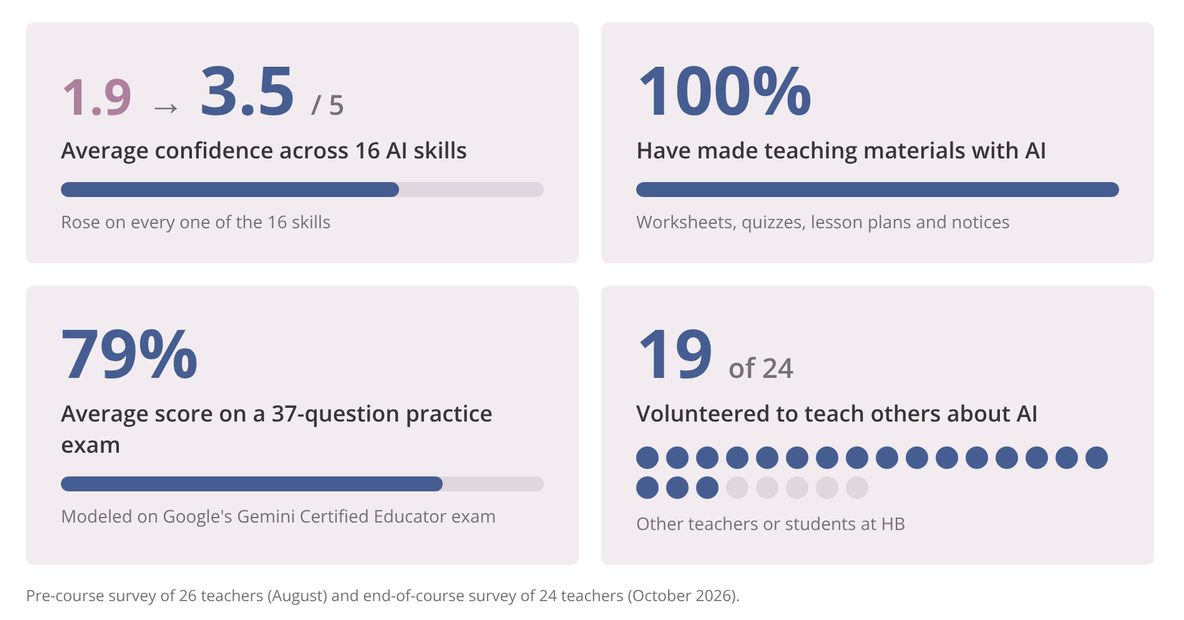
The training also made teachers more aware of the risks. By the end, they took issues like cyberbullying, leaked exam papers, and over-reliance on AI more seriously, and felt better prepared to handle them.
Teacher Quotes
One Mathematics teacher described a lesson with the school's youngest students:
"After this course, I used AI to prepare a lesson plan, worksheet and simple quiz for my Class 1 students. It helped me prepare teaching materials more quickly and gave me more ideas for activities and questions. The students enjoyed the activities and participated more actively in the lesson."
Pratyush Kumar Pradhan, a Chemistry teacher, wrote:
"Before this course I was hesitant about integrating artificial intelligence into my daily lesson planning. Now I actively use AI prompts to enhance classroom engagement and differentiate learning for my students."
Swati Swagatika Rout, who teaches Arts and Crafts, shared:
"I will teach students to use AI as a learning support, not as a way to copy answers."
Looking Ahead
While many of the teachers at HB began unsure or afraid, they finished making real lessons, setting clear rules for their students, and asking to learn more.
We hope to bring this program to more of C2C's partner schools, so that more educators, and the students they teach, can benefit.
We are grateful to the teachers and leadership at Hariharananda Balashram for their time and enthusiasm, and to the supporters who make this work possible.
Sources
Over 70% of Indian Teachers Now Use AI Tools, But Misconceptions Persist: CENTA Survey of 5,000 Educators, Education Matters, July 2025
What you need to know about UNESCO's new AI competency frameworks for students and teachers, UNESCO, September 2024
India needs to double down on bridging its digital gender gap, UNFPA India, March 2023
Pre-course survey (26 teachers, August 2026), session activity forms and end-of-course evaluation (24 teachers, October 2026), The AI Access Project